TL;DR: Many Amazon sellers think they're profitable until they account for FBA fees, ads, and returns. This guide walks you through a complete, repeatable profit margin calculation so you can launch and scale with confidence.
Key Takeaways
- Revenue is not profit, since Amazon FBA fees, ads, and returns can erase margins fast.
- True profitability starts with landed cost: include COGS, freight, duties, prep, and packaging.
- Use break-even ACoS to set safe ad spend limits and avoid losing money on PPC.
- Scenario planning (best/base/worst case) helps you stress-test pricing and inventory decisions.
- Optimize size tiers, pack counts, and return rates to reduce FBA fees without hurting conversion.
Table of Contents
- Why FBA Fee Math Decides Profit (Even When Sales Look "Good")
- The Complete Amazon Fee Breakdown (What You Must Include)
- Gather Your Inputs (So the Calculator Isn't Guesswork)
- Step 1: Calculate Landed Cost (Your True Cost Per Unit)
- Step 2: Calculate Total Fees Per Sale (Amazon + FBA)
- Step 3: Profit Margin Calculation (The Only Formula You Need)
- Step 4: Break-Even ACoS (The Metric That Stops You From Bleeding Cash)
- Step 5: Scenario Planning: Best Case / Base Case / Worst Case
- Step 6: Cost Control Levers (How to Improve Margin Without Killing Conversion)
- Common Mistakes That Make Sellers Lose Money
- Mini Walkthrough: Profit Calculation for One SKU (Example)
- FAQ
- References
Note on marketplaces: This guide is specifically optimized for the US market.
Why FBA Fee Math Decides Profit (Even When Sales Look "Good")
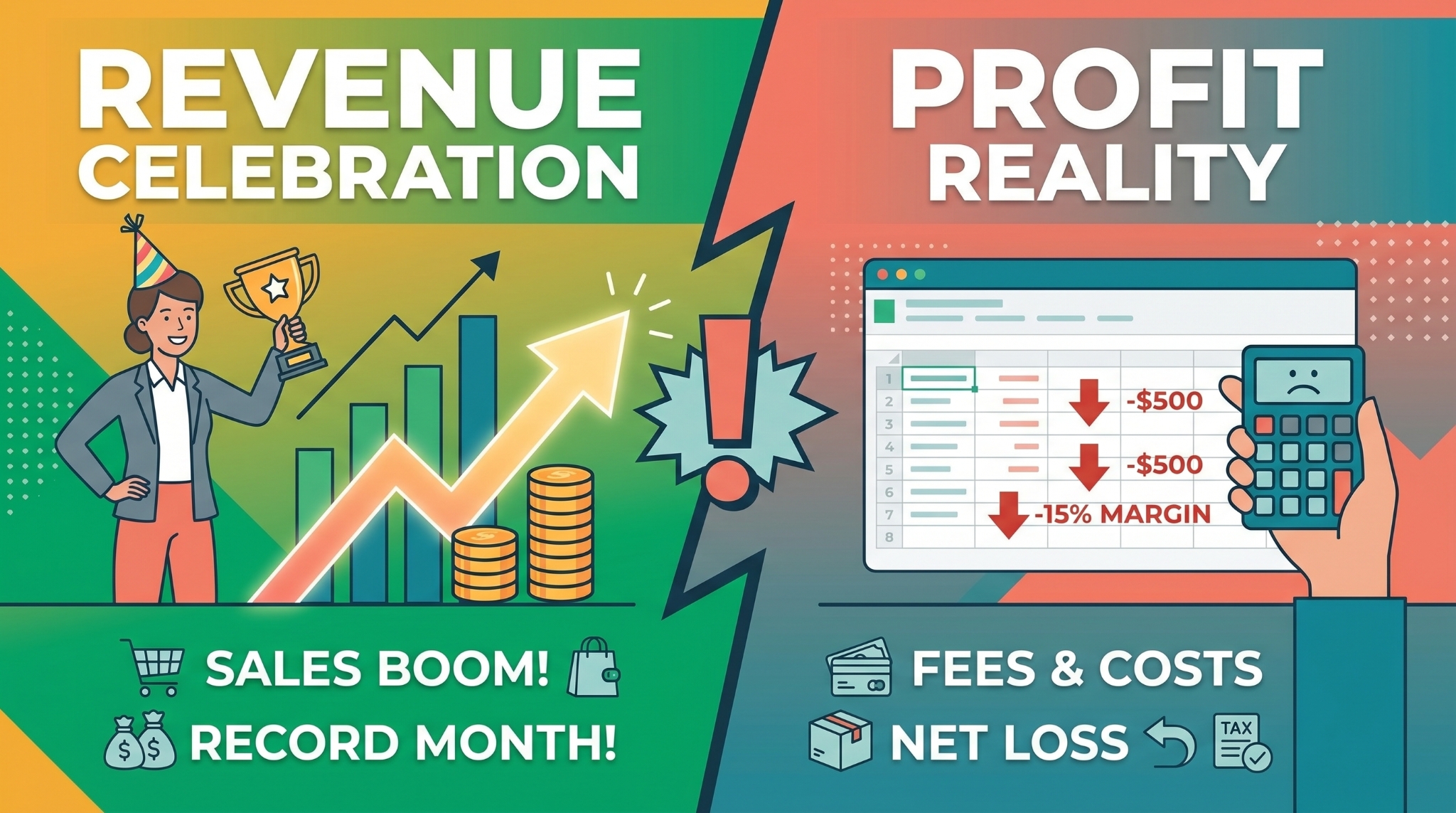
It's easy to get excited when your Amazon product starts selling. But high sales volume doesn't guarantee profit, especially with FBA. Many sellers overlook hidden fees, ad spend, and return costs, only to realize later they're operating at a loss.
The most common profit illusion: revenue ≠ profit
Revenue is just the top line. Profit is what's left after every cost: product, shipping, Amazon fees, advertising, returns, and more. A $30 sale might only net $5 after all deductions. Always calculate profit per unit, not just revenue.
The 3 profit killers: fees, ads, and returns
Three silent killers erode Amazon profits:
- Fees: Amazon's referral and FBA fulfillment fees can total 25-35% of your selling price.
- Ads: Poorly managed PPC campaigns can consume 30%+ of revenue, especially during launch.
- Returns: High return rates (common in apparel, electronics) add disposal fees and lost inventory value.
What this guide gives you: a repeatable calculation + decision rules
This guide provides a step-by-step framework to calculate true profitability. You'll learn how to:
- Build a complete landed cost model
- Estimate all Amazon fees accurately
- Factor in ads and returns
- Set safe ACoS targets
- Run scenario tests before launching
The Complete Amazon Fee Breakdown (What You Must Include)
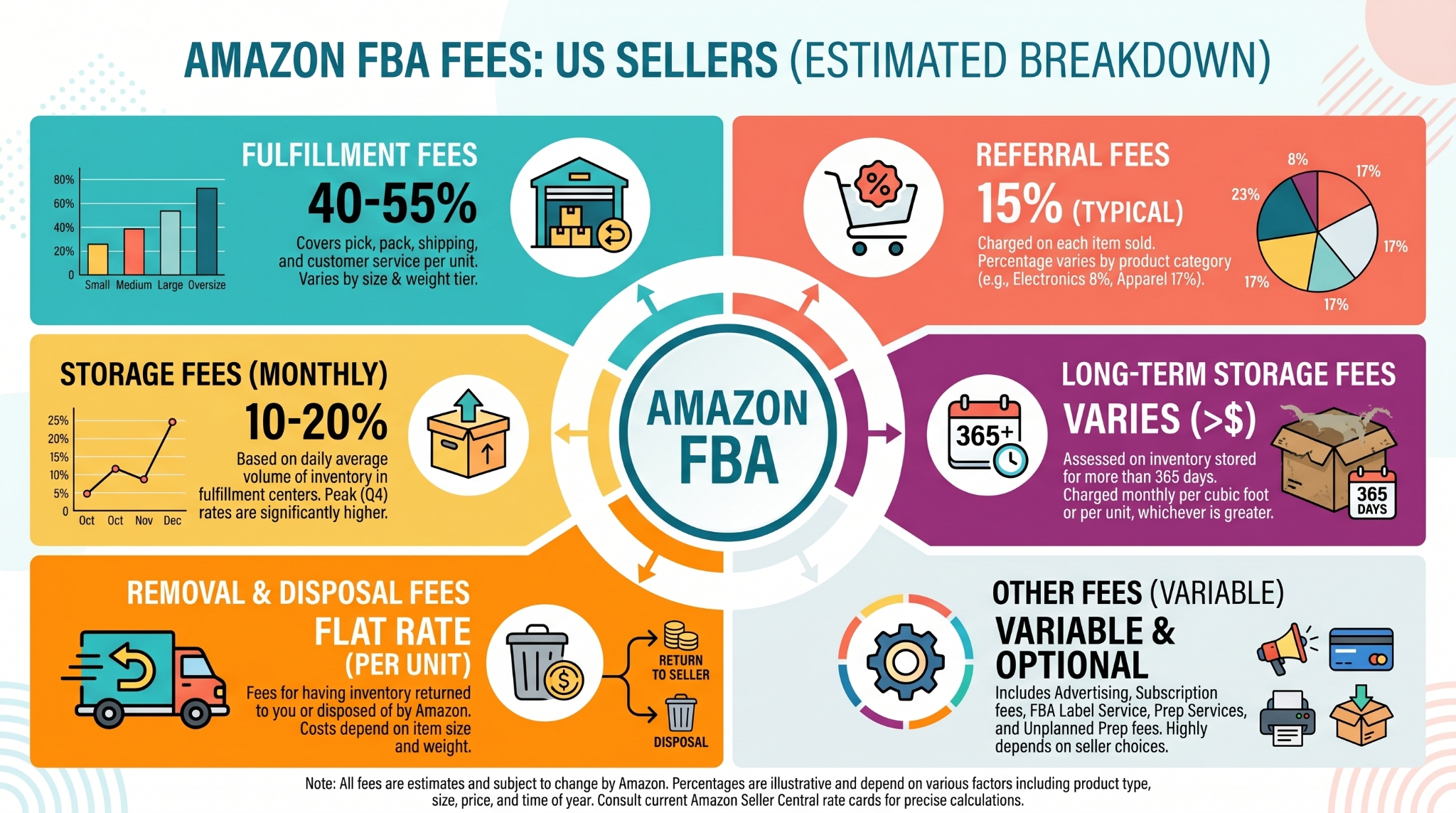
To calculate profit accurately, you must account for every fee Amazon charges. Here's a full breakdown of what to include.
Amazon selling fees (platform-level)
Referral fee (category-based)
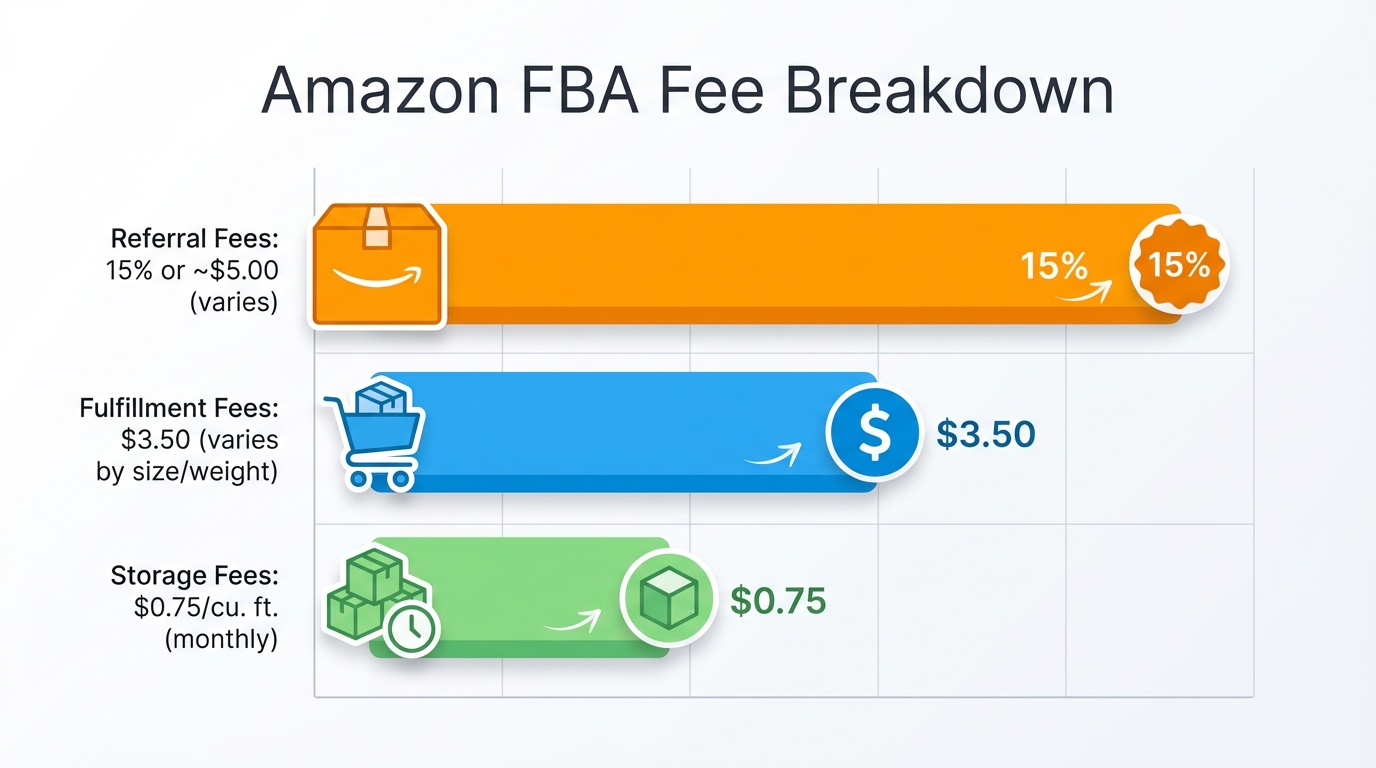
Amazon charges a referral fee on every sale, typically 8-15% depending on the category. For example:
- Electronics: 8%
- Home & Kitchen: 15%
- Apparel: 17%
This fee is calculated on the total selling price, including shipping and gift wrap.
Closing fee / other category fees (when applicable)
Some categories have fixed closing fees. For example, media items (books, DVDs) have a $1.80 closing fee per unit in addition to the referral fee.
FBA fees (fulfillment-level)
FBA fulfillment fee (size tier + shipping weight)
This is Amazon's fee to pick, pack, and ship your product. It depends on:
- Size tier: Standard-size, small standard, oversize
- Weight: Shipping weight (not just product weight)
For example, a 12 oz standard-size item might cost $4.28 to fulfill.
Monthly storage fees (standard vs. peak season)
Amazon charges monthly storage fees based on cubic feet. Rates increase during peak season (Oct-Dec). As of 2026:
- Standard-size: $0.78 per cubic foot per month (January-September) and $1.02 per cubic foot during peak season (October-December)
- Oversize: $0.60 per cubic foot (January-September) and $0.74 per cubic foot during peak season
Aged inventory / long-term storage risk (policy-dependent)
Items stored over 365 days incur long-term storage fees, either $6.90 per cubic foot or a per-unit fee, whichever is greater. This can destroy margins on slow-moving stock.
"Hidden" but real costs sellers forget
Returns, refunds, and disposal/removal fees
Amazon handles returns, but you pay. You may owe:
- Full refund to customer
- Disposal fee ($0.15-$0.60/unit)
- Removal shipping fee (if sending back to you)
Prep, labels, polybags, and packaging inserts
If your product needs special prep (e.g., polybagging, labeling), Amazon charges $0.10-$0.50 per unit. Factor this into your landed cost.
Inbound shipping to Amazon + warehouse placement costs
Your freight cost to get inventory to Amazon isn't free. Also, multi-channel or distributed placement can add $0.30-$1.00 per unit.
Promotions (coupons, deals) and price drops
Discounts reduce your selling price, which lowers referral fees but also cuts into margin. Always model promo impact before launching.
Gather Your Inputs (So the Calculator Isn't Guesswork)
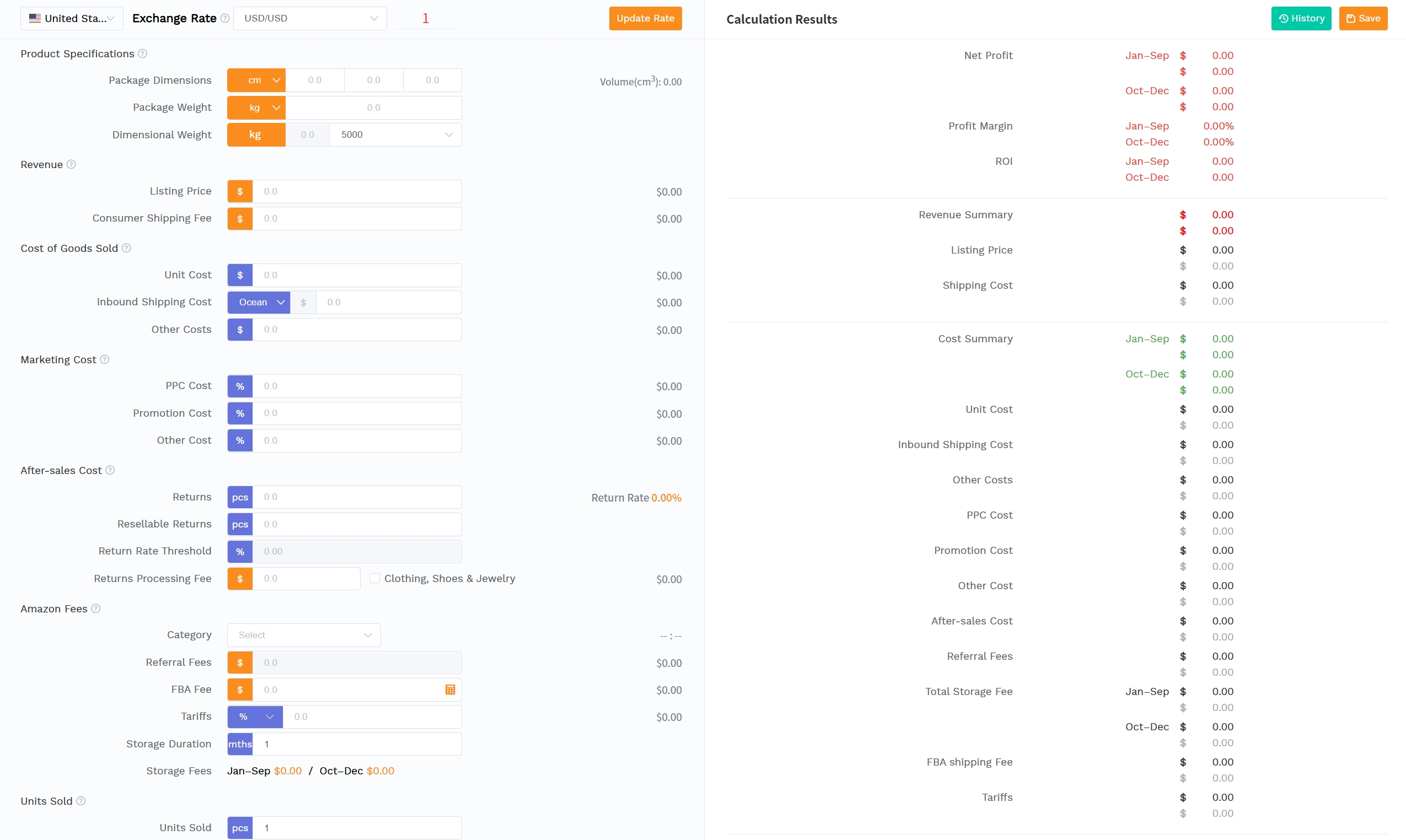
Accurate profit calculation starts with accurate inputs. Don't rely on estimates; gather real data for every cost.
Product inputs: size/weight, pack count, variants
Measure your product's dimensions and weight precisely. Use the heaviest variant for safety. Include packaging weight. Know your pack count (e.g., 2-pack vs. single).
Cost inputs: COGS, packaging, prep, freight, duties
Get exact numbers from your supplier. Include:
- Unit cost (COGS)
- Inner/outer packaging
- Prep labor or third-party prep cost
- Sea/air freight per unit
- Duties and tariffs (e.g., Section 301)
Selling inputs: price, expected return rate, promo plan
Set a realistic selling price based on competition. Estimate return rate by category (e.g., 5% for home goods, 15% for apparel). Plan for at least one coupon or deal.
Advertising inputs: expected CPC, CVR, target ACoS
Research average CPC in your niche ($0.50-$2.00). Estimate conversion rate (CVR) based on reviews and content quality (10-20%). Set a target ACoS (e.g., 25-35% for launch).
Inputs Checklist
| Category | Input | Status |
|---|---|---|
| Product | Dimensions, weight, pack count | ✅ Collected |
| Cost | COGS, packaging, freight, duties | ✅ Collected |
| Selling | Price, return rate, promo plan | ✅ Estimated |
| Ads | CPC, CVR, target ACoS | ✅ Researched |
Step 1: Calculate Landed Cost (Your True Cost Per Unit)
Landed cost is your total cost to get one unit to an Amazon customer's door. It's the foundation of profit calculation.
Landed cost formula (simple and practical)
Unit cost + packaging + prep + freight + duties/tariffs + inspections
Example:
- COGS: $5.00
- Packaging: $0.50
- Prep: $0.20
- Freight: $1.00
- Duties: $0.30
- Landed Cost: $7.00
How to handle MOQs and tooling costs (amortization)
If you paid $2,000 for tooling and ordered 1,000 units, amortize $2.00 per unit. For 5,000 units, it's $0.40. Always spread fixed costs over expected sales volume.
Build buffers for reality (damage, delays, currency swings)
Add a 3-5% buffer to landed cost for unexpected costs like damaged goods, port delays, or currency fluctuations.
= COGS + Packaging + Prep + Freight + Duties + (Tooling / Units) + Buffer
Example: = $5 + $0.50 + $0.20 + $1 + $0.30 + $0.40 + $0.20 = $7.60
Step 2: Calculate Total Fees Per Sale (Amazon + FBA)
Now calculate what Amazon takes per sale. This includes referral fees, fulfillment, storage, and return allowances.
Referral fee: estimate by category and selling price
For a $25 item in Home & Kitchen (15% referral fee): $3.75.
Fulfillment fee: estimate by size tier and shipping weight
Use Amazon's FBA calculator to get accurate rates. For a 12 oz standard-size item: ~$4.28.
Storage fees: estimate monthly and account for Q4 spikes
If you store 10 cu ft for 6 months at $0.94/cu ft, that's $56.40 total. Divide by units sold to get per-unit cost.
Returns/refunds: convert return rate into a per-unit cost
For a 10% return rate and $25 price, you lose $2.50 in revenue per unit sold. Add disposal fees (~$0.30) for total return cost of $2.80 per unit.
Step 3: Profit Margin Calculation (The Only Formula You Need)
Now combine everything to calculate your true profit margin.
Contribution margin per unit (before ads)
Price - landed cost - Amazon fees - FBA fees - return allowance
Example: $25 − $7.60 − $3.75 − $4.28 − $2.80 = $6.57
Net margin (after ads)
Contribution margin − ad spend per order
If ACoS is 30%, ad spend per order is $7.50. Net margin: $6.57 - $7.50 = −$0.93 (you're losing money).
Margin targets by stage (launch vs. mature)
- Launch: Aim for 15-20% net margin after ads to allow for learning.
- Mature: Target 25%+ for sustainability and reinvestment.
• Gross Margin: (Price − COGS) / Price
• Contribution Margin: After all fees, before ads
• Net Margin: After ads and returns
Step 4: Break-Even ACoS (The Metric That Stops You From Bleeding Cash)
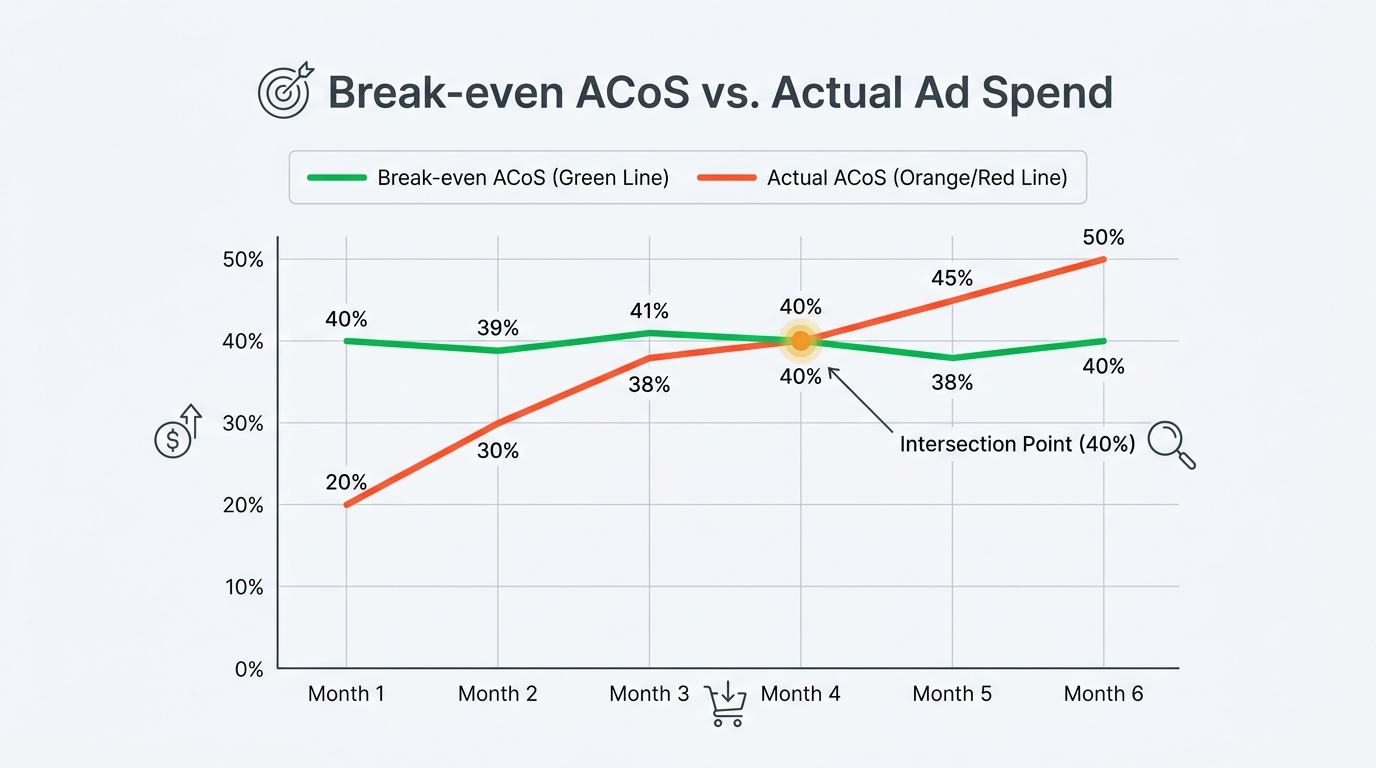
Break-even ACoS tells you the maximum ad spend you can afford without losing money.
Break-even ACoS formula (seller-friendly)
Break-even ACoS = (Price − total non-ad costs) ÷ Price
Using the example: ($25 − $18.43) / $25 = 26.3%. If your ACoS exceeds 26.3%, you lose money.
Why break-even ACoS changes with coupons and price drops
A $5 coupon reduces your effective price to $20, lowering break-even ACoS to 7.8%. Always recalculate during promotions.
How to set target ACoS by goal (rank vs. profit)
- Ranking goal: Run at break-even ACoS to gain visibility.
- Profit goal: Stay below break-even ACoS.
Step 5: Scenario Planning: Best Case / Base Case / Worst Case
Don't rely on one forecast. Test multiple scenarios to prepare for uncertainty.
Build 3 scenarios using realistic ranges
Vary CPC, CVR, and return rate:
- CPC: $0.80-$1.50
- CVR: 10-20%
- Return rate: 5-15%
The "pricing stress test" (how low can you price and survive?)
Test price drops to $20 or $18. Recalculate break-even ACoS and net margin. Can you still profit?
Inventory stress test (storage + aged inventory risk)
What if only 50% of inventory sells in 6 months? Calculate storage and long-term fees. Adjust order size accordingly.
Scenario Analysis Table
| Scenario | Net Margin | Break-even ACoS |
|---|---|---|
| Best Case (low CPC, high CVR) | 18% | 30% |
| Base Case | 5% | 26% |
| Worst Case (high returns, high CPC) | −12% | 22% |
Step 6: Cost Control Levers (How to Improve Margin Without Killing Conversion)
If margins are tight, use these levers to improve without hurting sales.
Reduce landed cost (supplier negotiation, packaging redesign, freight optimization)
Negotiate better pricing, switch to lighter packaging, or consolidate shipments to reduce freight cost per unit.
Reduce fees (size/weight tier optimization, pack strategy, dimensional changes)
A small change in dimensions can drop you from standard to small standard size tier, saving $1+ per unit.
Reduce returns (better sizing, clearer expectations, packaging protection)
Improve product images, add size charts, and use better packaging to reduce damage and buyer remorse.
Reduce ad waste (long-tail keywords, negatives, better creative)
Use precise keywords, negative keywords, and A+ content to improve CVR and lower ACoS.
Common Mistakes That Make Sellers Lose Money
Avoid these pitfalls that sink otherwise promising products.
Ignoring returns and refunds
Returns aren't free. Factor in disposal fees and lost inventory value.
Using "gross margin" while forgetting ads and coupons
Gross margin looks good until you spend 30% on ads. Always calculate net margin.
Not updating fees after size/weight changes
A packaging tweak might change your size tier. Always recheck FBA fees.
Scaling PPC without knowing break-even ACoS
Doubling ad spend without knowing your break-even point can lead to massive losses.
Over-ordering and paying storage/aged inventory fees
Order based on realistic sales velocity, not optimism.
Mini Walkthrough: Profit Calculation for One SKU (Example)
Inputs (price, COGS, fees, CPC, CVR)
- Price: $25
- COGS: $5.00
- Packaging: $0.50
- Freight: $1.00
- Duties: $0.30
- Tooling: $0.40
- Buffer: $0.20
- Landed Cost: $7.40
- Referral Fee: $3.75
- Fulfillment: $4.28
- Return Allowance: $2.80
- ACoS: 30%
Output (contribution margin, net margin, break-even ACoS)
- Contribution Margin: $6.77
- Ad Spend per Order: $7.50
- Net Margin: −$0.73
- Break-even ACoS: 26.3%
Decision: proceed / redesign / reprice / reject
With a negative net margin, this product isn't viable at current price and ad cost. Options:
- Reprice to $27+
- Negotiate lower COGS
- Optimize size tier
- Improve CVR to lower ACoS
FAQ
How can I calculate my profit margin after Amazon FBA fees?
Subtract your landed cost, Amazon referral fee, FBA fulfillment fee, storage, returns, and ad spend from your selling price. Divide by price to get net margin percentage.
What are the hidden fees in Amazon FBA that affect profit margins?
Hidden fees include long-term storage, disposal, prep, labeling, inbound freight, currency conversion, and return processing. Always include these in your landed cost.
What's a "good" profit margin for Amazon FBA?
Aim for 15-20% net margin during launch and 25%+ for mature products. Lower margins increase risk during competition or ad spikes.
How can I reduce FBA fees to improve my profit margin?
Optimize product dimensions to qualify for lower size tiers, reduce weight, minimize packaging, and avoid long-term storage with better inventory planning.
Next Steps
- Use the free SellerSprite Profit Calculator to run your own numbers.
- Read our Amazon Product Research Guide to find winning products with built-in margin.
- Sign up for SellerSprite and unlock advanced profit analytics and product research tools.
References
- Amazon FBA Fee Structure View
- Amazon Product Research Guide View
- Amazon Profit Calculator Ultimate Guide View
By SellerSprite Success Team
The SellerSprite Success Team combines deep Amazon marketplace expertise with data science to help sellers make smarter decisions. With years of experience in product research, profit modeling, and PPC optimization, we empower new and growing sellers to scale profitably.